TAKSU

Olan Ventura

loading...
i
i
i
i
i
i

Plastic Realism


At times contemporary human experience seems to straddle the real and the surreal, and nothing can be closer to this than the contemporary art emerging from the Philippines. One only has to experience the sprawling, chaotic hubbub of Manila to realize that humdrum reality for Filipinos can often be perceived as a strange mixture of circus acts in tandem with the harsher realities of life in the impoverished Third World.

Amidst this environment of fervent decay Olan Ventura (b. 1976) has been practicing his brand of surrealist examination for the past decade since receiving his Fine Arts degree from the University of the East in 1998. After numerous solo and group exhibitions, Ventura now ventures abroad with TOY BOX, his first solo exhibit outside the Philippines.

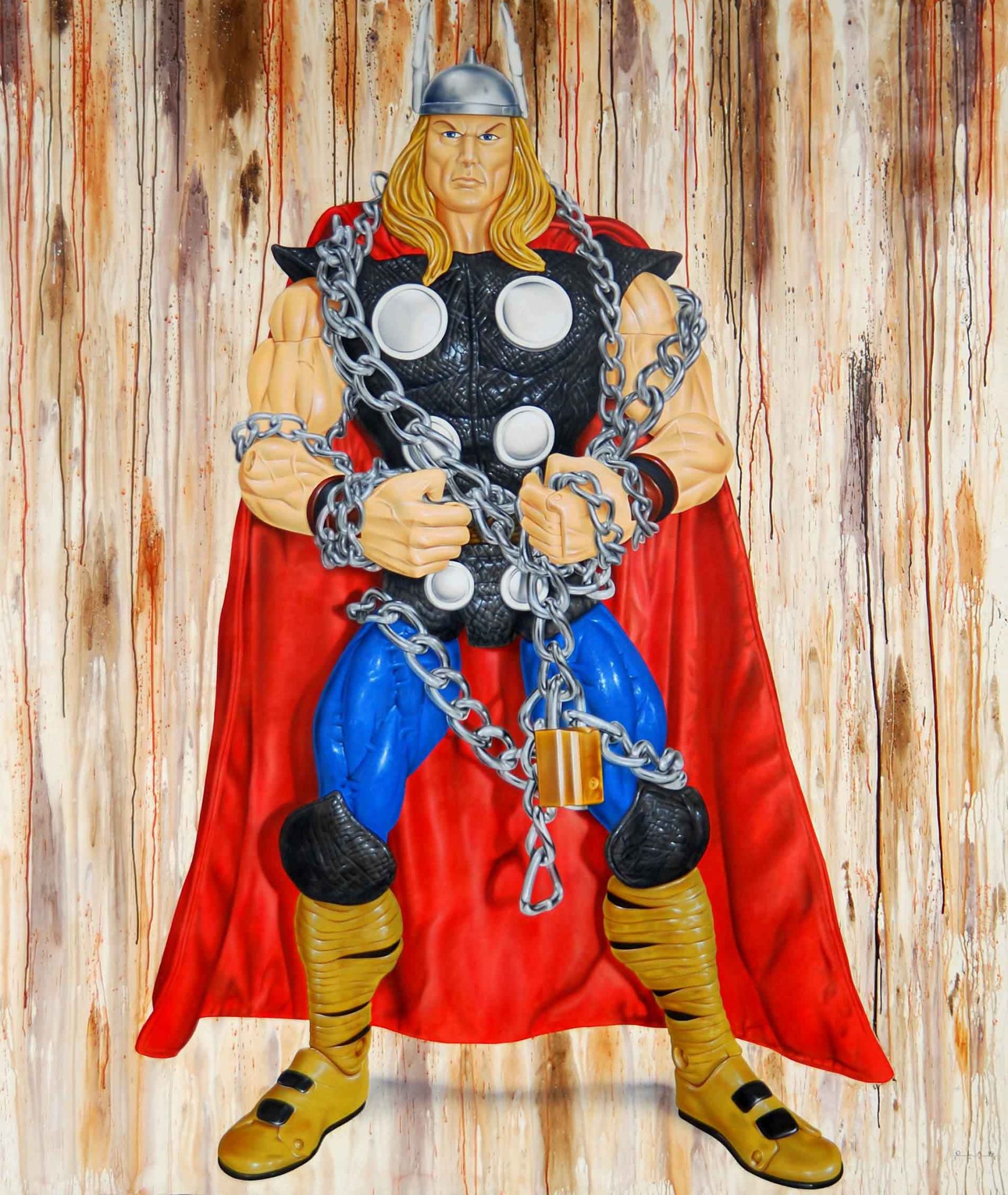
TOY BOX examines some of Ventura’s main thematic and stylistic preoccupations, and attempts to link these aspects of his art to the underlying message of his work. From a thematic point of view, much of Ventura’s output over the years has focused on his family and the tiny flat they used to occupy (they have since moved). From this somewhat dreary setting came a bevy of visual stimuli; for instance, portrayals of his family in a domestic setting that was almost stage-like in its stark, minimalist simplicity. Another development of this domestic theme, featured here in TOY BOX, focuses on imaginary figures that are more a part of his children’s world than his own, but imbued with a subtext that reflects an almost super-human need for deliverance as well as a rather ironic struggle of this imagined heroism in the face of real challenges.

Upon closer examination, Ventura’s TOY BOX works cannot be divorced from his stylistic preferences as a painter, which the artist curiously describes as Plastic Realism. Indeed, Ventura’s work is immediately related to the rich vein of realism that runs through much of contemporary Philippine art, the foundation of which is a relatively unsophisticated yet fundamentally grounded, classically inspired training many artists receive in the Philippines. For Ventura, this penchant for figurative, representational work is further imbued by such influences as pop art, minimalist color field studies that comprise much of his austere settings, as well as an attitude of simplicity and placid reflection that seem to mirror his circumstances. In TOY BOX this heightened sense of realism takes on a kind of hyperrealist plasticity, rendered with the same stunning technical ability that the artist is known for.

Though Ventura’s fascination with the super hero motif stems from a sense of playful exploration, he is also interested in the figurative implications of the subject matter as well as its pop cultural inferences. Almost to the degree of a sculptor or assemblage maker, he scours toyshop bins for figures which he then arranges in what can be described as various modes of confinement, mounting them on boards, then tying them up in wire or string, and even damaging them to some degree. What is left is virtually a remnant of a hero that, while retaining an integrity of form, has been altered somewhat to reflect a kind of vulnerability that is ironic and poignant at the same time.

This rather revealing bit of truth behind Ventura’s creative process offers a further irony to the term Plastic Realism. While his depictions retain a sense of the imaginary and all its iconic, pop cultural implications, they are in themselves clearly modeled from real plastic toys, replete with articulated limbs and the material sheen of plastic. Hence, Plastic Realism conveys both a sense of the unreal as well as the objective depiction of real, physical qualities. As if to underscore the real-ness behind his work, Ventura even provides, in each title, the scale in which the toy figure has been rendered.

Whatever references lay beneath or on the surface of Olan Ventura’s Toy Box works, the resulting artifacts remain a testament to both the power of the imaginary and the real. It demands the sensitivity of the viewer to see beyond the legend behind each figure, as iconic, heroic examples of our moral aspirations, to a reality that perhaps reflects the fallacy of such notions.

-Antonio Luz, February 2009